

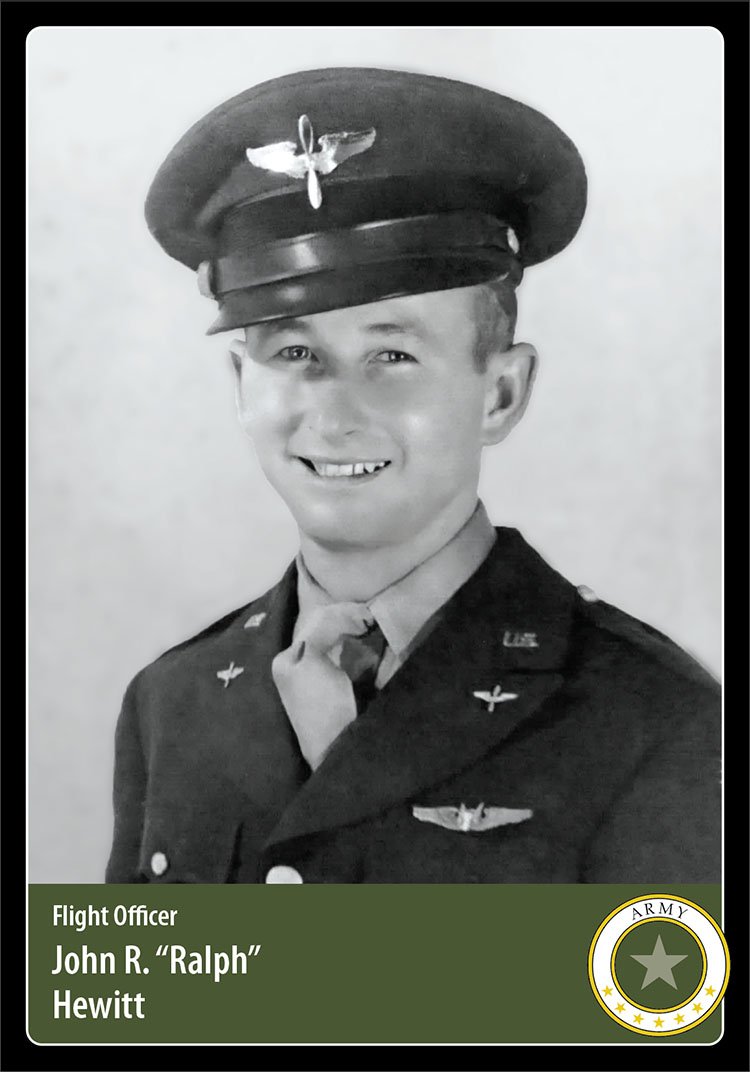
Hero Card 278, Card Pack 24
Photo (digitally restored) provided by the family.
Hometown: Blooming Grove, TX
Branch: U.S. Army (Air Forces)
Unit: 863rd Bomber Squadron, 493rd Bomber Group (Heavy), 8th Air Force
Military Honors: Air Medal with Oak Leaf Clusters, Purple Heart
Date of Sacrifice: September 12, 1944 - KIA over Magdeburg, Germany
Age: 25
Conflict: World War II, 1939-1945
“Ralph” Hewitt grew up in Blooming Grove, Texas—a small rural community located halfway between Dallas and Waco, in cattle and cotton country. He shared his first name, John, with his father, John Ivie Hewitt, and older brother, John Ivie Jr. His brother went by the name “Billy.” Along with their younger brother Charles, all three Hewitt boys would grow up to serve their country in the United States Army.
As a boy, Ralph’s family life was unsettled. He was a teenager during the Great Depression (1929-1939). His mother, Linnie Vee (McSpadden), married Reuben Donnell in 1928. Ralph stayed with various relatives, including his aunt, Ruby Ellis, who enrolled him at Blooming Grove High School.
According to his family, Ralph Hewitt participated in track and football and was a member of the Future Farmers of America (FFA). He was one of 21 graduates in Blooming Grove High School’s class of 1937. A photo of Hewitt in a football uniform shows that he was given the nickname “Red.”
After high school, Hewitt took a job with the AAA. In October of 1940, he decided to serve his country and reported to Kelly Field in San Antonio, Texas, where he enlisted in the United States Army Air Forces.
At the time, Adolph Hitler’s armies had swept across Europe, taking France in June 1940. The American public was reluctant to get directly involved in another global conflict. Up to this point, the United States limited its involvement to supplying the British with tanks, aircraft, food, and ammunition—lending its manufacturing might to the cause against Nazi Germany.
As the United States prepared for war, John Hewitt completed bombardier training at Deming Army Airfield in New Mexico on February 5, 1944. He was commissioned as a second lieutenant.
A surprise attack on the U.S. Pacific Fleet at Pearl Harbor, Hawaii, on December 7, 1941, launched the U.S. fully into World War II. Congress passed a declaration of war against Imperial Japan, and three days later, Nazi Germany and Italy—allied with Japan—declared war on the United States.
By 1944, Hewitt was a flight officer assigned to the 863rd Bomber Squadron, 493rd Bomber Group. As a bombardier on a B-17 “Flying Fortress” (43-38261), Hewitt was responsible for getting the aircraft’s bombs on target. According to the National Museum of the United States Air Force:
As the bomber approached its target, the bombardier entered data about wind direction, airspeed and altitude into the bombsight's analog computer, which calculated wind drift and provided the correct aim point. An internal gyroscope provided the stability necessary for using the telescopic sight at high altitudes.
F/O Hewitt’s 493rd Bomber Group was sent to the European Theater of Operations in May 1944, operating from Debach Airfield near Britain’s east coast. Their first combat mission came in support of Operation Overlord on June 6, 1944—the D-Day invasion of Normandy, France.
After D-Day, through the summer of 1944, the long-range B-24 and B-17 bombers of the 493rd flew dangerous missions deep into Germany, striking industrial and military installations that included gun batteries, airfields, rail tunnels, bridges, and factories.
On September 12, 1944, Hewitt’s squadron took off from Debach and flew across the English Channel. Their mission was to execute a bombing raid on a German ordnance factory in Magdeburg, 80 miles west of Berlin.
As they bombed the target, they encountered intense flak from German anti-aircraft guns. After successfully dropping their bombs, Hewitt’s formation of twelve B-17 bombers was attacked by a German Luftwaffe Sturmgruppe (storm group) at 23,000 feet, shortly after leaving the target area. Seven of the twelve B-17 bombers were shot down, including Hewitt’s.
F/O John Ralph Hewitt, at age 25, was lost when his B-17 Flying Fortress was shot down over Germany. He was laid to rest with his fellow soldiers and airmen at the Netherlands American Cemetery (Plot D, Row 1, Grave 14).

Sources
Details and card photo submitted by Ms. Melisa Taylor
American Air Museum in Britain: 863rd Bomb Squadron
Corsicana Daily Sun, Nov. 1, 1940: Other Enlistments
Corsicana Daily Sun, Feb. 9, 1944: In Uniform—Commissioned
Office of Air Force History—Air Force Combat Units of World War II, p. 362-363: 493rd Bombardment Group
Folds3 HQ: Unit History of the 493rd Bomb Group
HistoryNet: Ambush Over Magdeburg
American War Memorials Overseas, Inc.: 493rd Bombardment Group Honor Roll
Corsicana Semi-Weekly Light, Nov. 21, 1944: John R. Hewitt Is Killed In Action Raid Over Germany
Honor States: John R Hewitt
Burial Site: Find a Grave

