
Hero Card 287, Card Pack 24
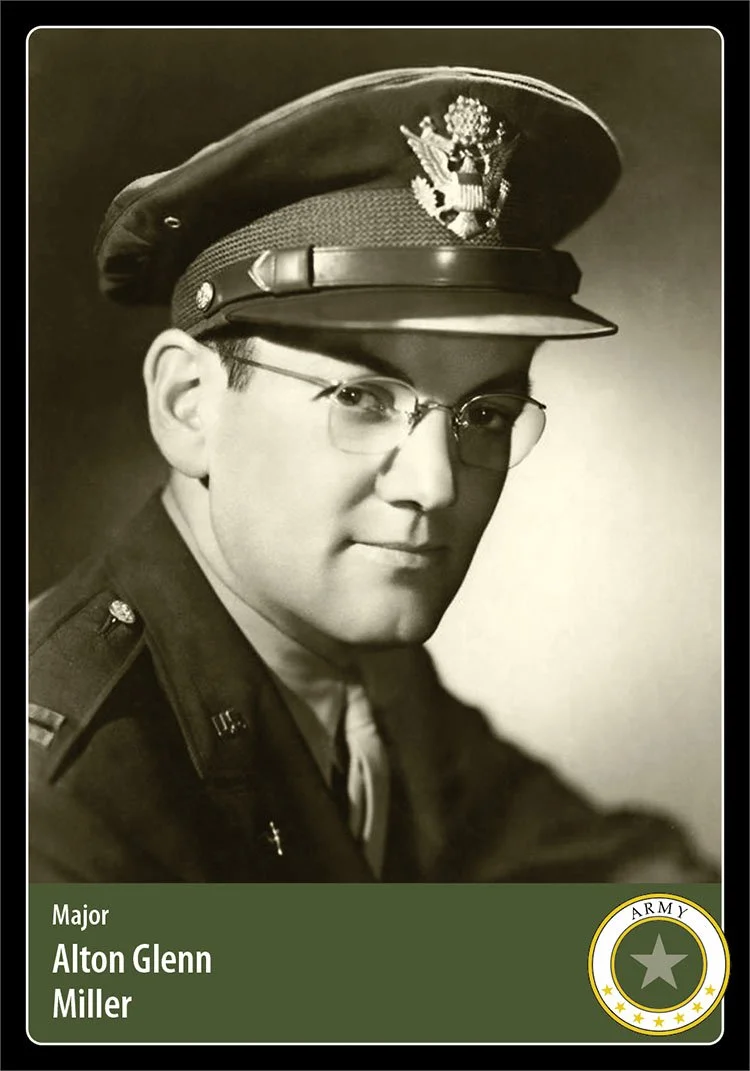
U.S. Army photo (digitally restored), Public Domain
Hometown: Clarinda, IA
Branch: U.S. Army (Air Forces)
Unit: American Band of the AEF
Military Honors: Bronze Star Medal
Date of Sacrifice: December 15, 1944 - Missing in Action between London, England and Paris, France
Age: 40
Conflict: World War II, 1939-1945
From the late 1930s to the early 1940s, the Glenn Miller Orchestra provided a soundtrack for the nation and for a troubled world.
For people born at the turn of the century, the chaotic world around them brought a deadly conflict in Europe (World War I, 1914-1918), followed by a global “Spanish Flu” epidemic (1918), a Great Depression (1929-1939), and a second, even more devastating global conflict (World War II, 1939-1945).
Glenn Miller brought music, dancing, and romance to a world desperate for hope. He became one of the top recording artists of the 20th century and, at the pinnacle of his enormous popularity, left it all to do his part in the Allied war effort during World War II
Life on the move
Alton “Glenn” Miller was born on March 1, 1904, in Clarinda, Iowa—a small town in the southwest corner of the state. Out of necessity, his father Lewis was a jack-of-all-trades and a homesteader. His mother Mattie Lou was a schoolteacher and tended to Glenn and his three siblings: older brother Elmer, younger brother John, and younger sister Emma.
Because of limited means and economic instability, the family moved frequently to pursue work opportunities. When Glenn was two years old, the family moved to a sod house in Tryon, Nebraska to homestead 640 acres.
Later moves brought the Miller family to North Platte, Nebraska and Grant City, Missouri. By the time Glenn was a teenager, they settled in Fort Morgan, Colorado in 1918. Glenn played football at Fort Morgan High School, where he showed enough talent to be named to Colorado’s all-state team as “the best left end in Colorado.”
Passion for Music
Miller’s interest in music had begun at a young age, when his father brought home a mandolin. He traded it in for a battered horn, which he practiced relentlessly. His mother worried about his obsession, recalling, “It got to where Pop and I used to wonder if he’d ever amount to anything.”
While Miller was in grade school in Grant City, Missouri, a town businessman who directed the community band, John Mosbarger, bought him a brand-new trombone so he could join in the band. Glenn worked for Mr. Mosbarger to pay off the instrument.
Miller graduated from Fort Morgan High School with the class of 1921 but skipped his graduation ceremony to play with a dance band in Laramie, Wyoming. When his mother went to pick up his diploma, the principal quipped, “Maybe you’re the one who should get it anyway. You probably worked harder on it than he did.”
Professional Career
Miller enrolled at the University of Colorado in Boulder but spent more time traveling to music auditions and playing his trombone anywhere and everywhere he could. After flunking three of his five college classes, he dropped out to focus on becoming a professional musician.
It was not his trombone playing that would bring Glenn Miller to the very top of the popular music industry. After his brief college stint, he toured and played with a number of different orchestras—from Los Angeles, California to New York City.
While earning a meager living in New York as a freelance trombonist, Miller sent for his college sweetheart, Helen Berger. The two were married in 1928.
Miller played for and recorded with several different orchestras and tried his hand at arranging music. He found moderate success in 1934, as the musical director of the Dorsey Band, and he later went on to organize The Ray Noble Orchestra.
He formed his own band in 1937, made a few recordings, and secured short engagements in Dallas and New Orleans. As opportunities dwindled to one-night gigs, Miller had to close down the band and return to New York.
Defining an era
A year later, a second “Glenn Miller Orchestra” was assembled, and would come to define the Big Band sound of the late 1930s and early 1940s. As Miller famously said, “A band ought to have a sound all of its own. It ought to have a personality.”
According to History Colorado and the Colorado Encyclopedia:
Miller’s ideal sound, as he described it, was the velvet depth achieved when the entire band worked as one instrument. Miller’s bands often used a clarinet-led saxophone section in search of this sound, which is best realized in his most famous song, “Moonlight Serenade.” First recorded on April 4, 1939, the song became one of the most popular of the big band era.
From 1939 until his death in 1944, Miller’s records soared on the charts. During those five years, he earned as much as half a million dollars in record royalties. In addition to “Moonlight Serenade,” some of the Miller Band’s best-known hits included “In the Mood,” “Tuxedo Junction,” and “Chattanooga Choo Choo.”
The Glenn Miller Orchestra became America’s most popular band. Miller was the first artist ever to receive a Gold Record Award—honoring the 1,200,000th sale of “Chattanooga Choo-Choo.”
Bringing “a little bit of home”
After years of struggling to find success, at the very height of his popularity Glenn Miller walked away from his famous orchestra for a more important mission.
In September of 1942, he disbanded his orchestra so join the U.S. Army Air Forces and do his part for the war effort. According to the National Museum of the United States Air Force:
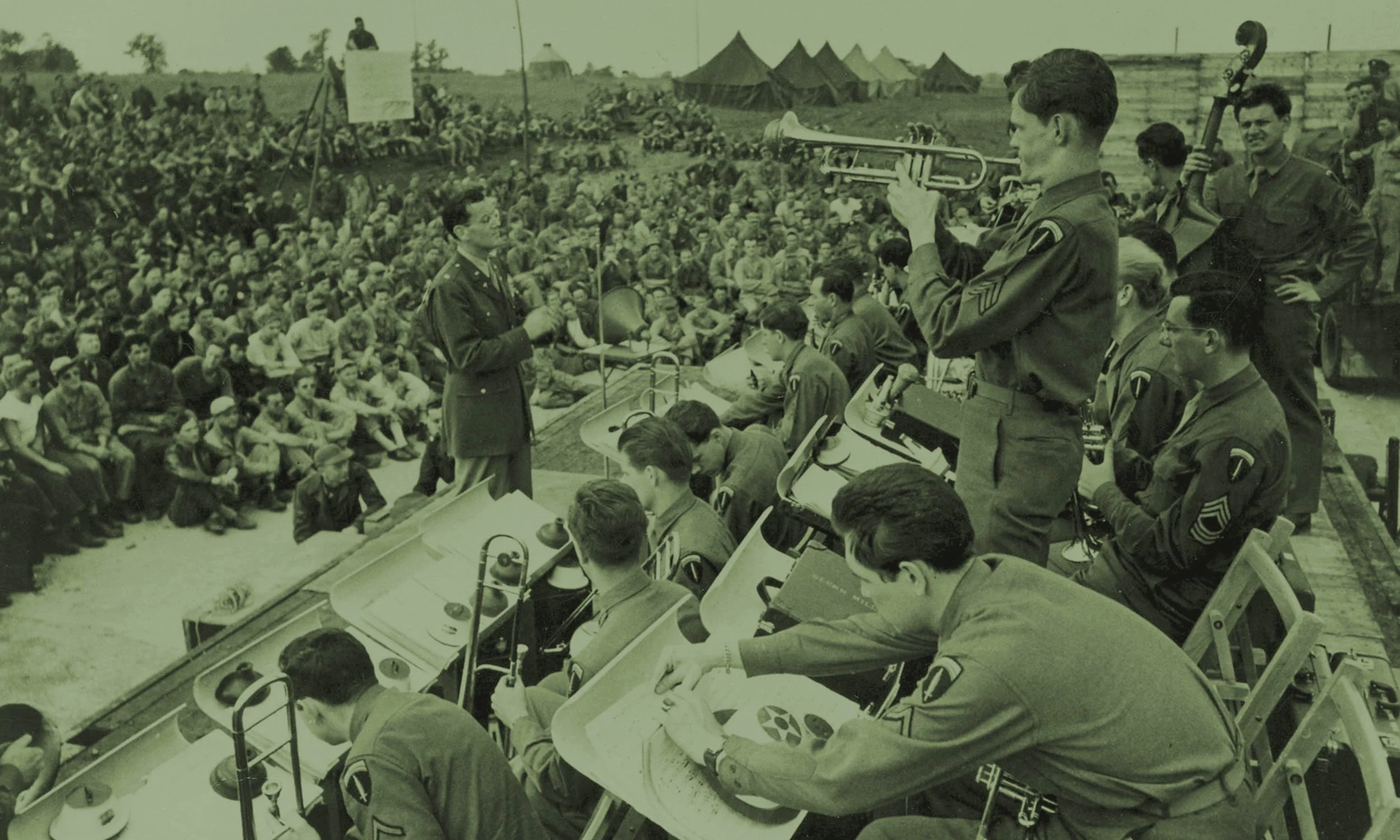
Within a year, he organized and perfected what has been widely accepted as the greatest aggregation of dance musicians ever forged into a single unit, the Maj. Glenn Miller Army Air Force Band.
The band was transferred from the United States to England in June 1944 and immediately began playing in theaters, clubs, hospitals, hangars and even out in the open—anywhere that U.S. servicemen could gather. In the 15 months the unit served in Europe, it made more than 350 personal appearances, attended by 1,250,000 military personnel. In addition, it made more than 500 radio broadcasts for the pleasure of millions of other soldiers. It brought “a little bit of home” to the lonely serviceman in foreign lands and was enjoyed by our Allies as well.
Mysterious disappearance
By August 1944, Allied forces had liberated Paris. Glenn Miller was eager to leave England and get to the European continent, where he could bring some relief to the American soldiers on leave.
A Christmas Day performance was scheduled, and the logistics of getting a 60-piece orchestra into Paris were daunting. Miller would fly ahead to finalize the many details related to lodging and coordinating a large public event.
The National WWII Museum describes what took place in December 1944:
Celebrities, like Miller, were required to have all air transportation formally approved, but Miller was too focused on the task at hand to worry about military bureaucracy. When he ran into his friend Lieutenant Colonel Norman Baessell, who offered Miller a seat on a flight to Paris on December 15, he didn’t hesitate to accept.
Inclement weather continued on the 15th, but when a UC-64A Norseman landed at Twinwood Farm Airfield just before 2 p.m., Miller and Baessell boarded the plane. Piloted by Flight Officer John R. Stuart Morgan, the transport plane had to be flown below the cloud cover, anywhere from 1,500 to 3,000 feet. It was not an ideal day for a flight, and Miller and Baessell were not officially recorded on any manifests.
When the rest of the band arrived in Paris on December 18, 1944, Major Glenn Miller was nowhere to be found.
On Christmas Eve, 1944, the world learned that Maj. Alton “Glenn” Miller, age 40, had gone missing somewhere over the English Channel. His fate and the fate of the other men on his plane remains a mystery.
The Maj. Glenn Miller Army Air Forces Band played on, even with the devastating loss of their beloved leader. The wreckage of Miller’s aircraft was never found, and he was officially listed as Missing in Action.
Legacy
Just before his death, Maj. Miller and his wife Helen had adopted a son, Stephen, and a daughter, Jonnie—a daughter that Glenn never met.
Miller will rightly be remembered for the legacy of his music. He left behind a discography as enduringly popular as any artist in the history of recorded music—with sixteen number one hits in four years.
But he must also be remembered for his service to his country. He walked away from enormous fame and fortune to put himself in harm’s way, bringing “a little bit of home” to a war-weary generation—who also left home, to liberate the people of Europe and the Pacific.
In 1954, Universal Pictures cast actor Jimmy Stewart in the lead role of the film The Glenn Miller Story.
At his adopted daughter’s request, a cenotaph headstone is dedicated to the bandleader at Arlington National Cemetery, in Memorial Section H.

Sources
Apple Music: Glenn Miller Essentials
National Archives: Official Military Personnel File for Alton Glenn Miller
Glenn Miller Orchestra: Highlights and A Short Biography
The Glenn Miller Birthplace Society: The Boyhood Home of Glenn Miller
Colorado Encyclopedia: Alton “Glenn” Miller
National Museum of the United States Air Force: Maj. Glenn Miller Army Air Force Band
The National World War II Museum: Major Glenn Miller, US Army Air Forces
The National World War II Museum: Major Glenn Miller: The Loss of an Icon
BBC: What happened to Glenn Miller? The 80-year mystery
USO: Glenn Miller: Military’s Music Man
Arlington National Cemetery: Glenn Miller

