
Hero Card 285, Card Pack 24
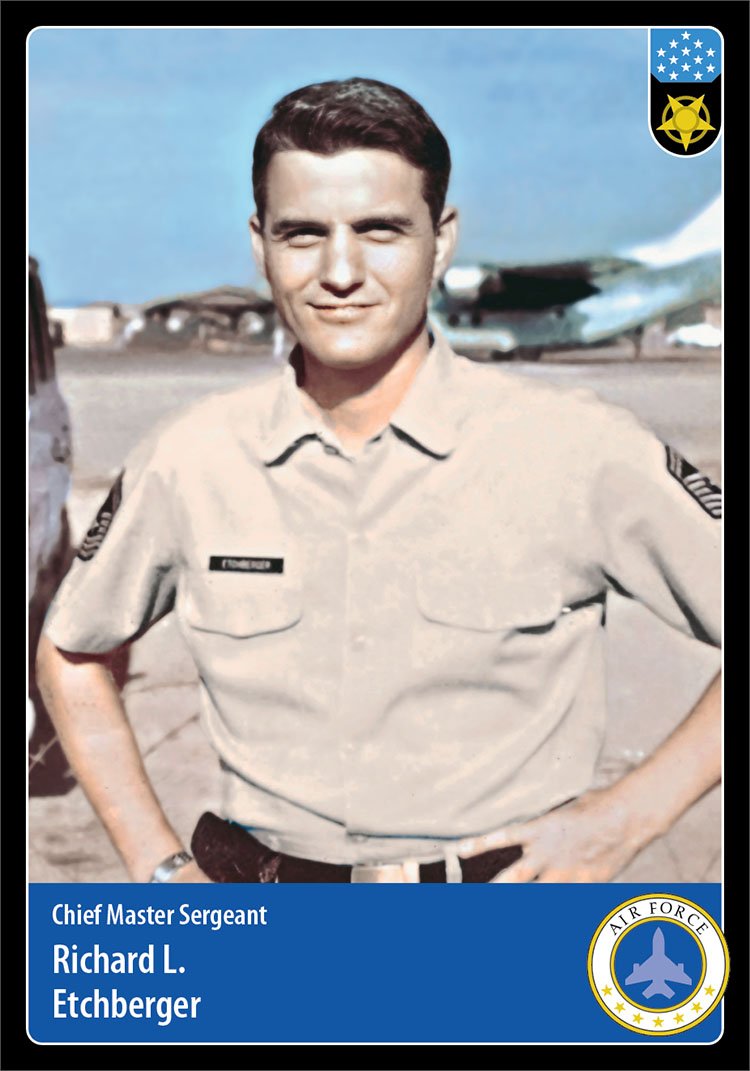
Photo credit: U.S. Air Force photo (digitally restored), Public Domain
Hometown: Hamburg, PA
Branch: U.S. Air Force
Unit: 1043d Radar Evaluation Squadron
Military Honors: Medal of Honor, Air Force Cross, Purple Heart
Date of Sacrifice: March 11, 1968 - KIA in Phou Pha Thi, Laos
Age: 35
Conflict: Vietnam War, 1959-1975
Because his mission was highly classified, and his presence at a mountaintop radar site in Laos had political and military implications, Chief Master Sergeant Richard “Dick” Etchberger’s brave actions would remain a national secret for decades.
Dick and his brother Bob were raised by Donald and Kathryn Etchberger in Hamburg, Pennsylvania. Hamburg is a small town in the eastern part of the state, nestled along the banks of the Schuylkill River in the foothills of the Appalachian Mountains.
Their father worked at a hosiery mill in Hamburg, making silk stockings—until Imperial Japan attacked the U.S. Navy’s Pacific Fleet at Pearl Harbor, Hawaii. Dick was just eight years old, and life changed quickly for the Etchberger family as the nation was thrust into war. The War Department needed silk for parachutes, and Donald lost his livelihood as the Hamburg mill was closed.
Dick and Bob worked odd jobs to help provide for the family. Eventually, Donald found work as a stockman in a small store and moved the family to nearby Minersville.
Bob remembers that Dick was a star basketball player who excelled academically. “Dick had a photographic memory,” recalled Bob. “When he would go upstairs to study, he would be done in ten minutes. Then he was back downstairs doing whatever he wanted. That used to infuriate me because I couldn’t learn my lessons that quickly.”
The family returned to Hamburg after the end of World War II. Dick graduated from Hamburg High School in 1951 and earned extra money by helping his father, who was employed at a Hamburg department store.
Military service
A few weeks after graduation, in August 1951, Etchberger enlisted in the United States Air Force. He left Hamburg for Basic Training at Lackland Air Force Base in San Antonio, Texas. He was sent to Airmen Electronic Fundamentals School for five months, then Radar Maintenance School for seven, both at Keesler Air Force Base in Biloxi, Mississippi. In October 1953, Etchberger was qualified as a Radar Operator, then as an Auto Track Radar Specialist by May of 1954.
Etchberger had hoped to become a pilot. Because of a head injury he suffered in high school, he experienced headaches and equilibrium problems and had to drop out of pilot training. But he earned a reputation as an electronics whiz, finding his calling and his career with the Air Force.
Regular promotions came, along with assignments and more training at Hill Air Force Base in Ogden, Utah, and McClellan Air Force Base in Sacramento, California.
Family life
While stationed in Utah in 1956, Etchberger married Catherine Vaccaria, whom he met at a Salt Lake City restaurant where she worked. Dick became a father to Katherine’s 8-year-old son, Steve, and the Etchbergers later welcomed two more sons—Richard and Cory.
More promotions and assignments kept the family on the move. Air Force responsibilities sent the family to Sidi Slimane Air Base in Marrakesh, Morocco, to Bismarck, North Dakota, to Clark Air Base in the Philippines, to Hon Tre Island in the Republic of Vietnam, and to Chanute Air Force Base in central Illinois.
Top-Secret Mission
By the mid-1960s, America was embroiled in a Cold War with the Communist Soviet Union and in an active war in Vietnam. Needing his expertise in radar technology—and his experience with complex radar set installations—the Air Force tapped Dick Etchenberg, now a Chief Master Sergeant, for an important and secretive mission.
He was assigned to the 1043d Radar Evaluation Squadron and sent to a remote Laotian mountaintop radar station known as Lima Site 85. The installation was located 15 miles from enemy North Vietnam’s shared border, and was part of a top-secret mission with the Central Intelligence Agency (CIA), code-named Operation Heavy Green.
According to the National Museum of the United States Air Force, Heavy Green “…was manned by hand-picked, volunteer USAF technicians. These men were ‘sheep dipped’—they ‘officially’ left the Air Force and became civilians but remained under its command. When the mission was over, they were to be reinstated in the Air Force with no loss of rank or pay.”
U.S. military personnel were prohibited from serving in Laos at the time because the country was officially neutral in the Vietnam conflict. Etchberger and his small team were disguised as civilian contracted employees, working for Lockheed Corporation.
Courage under fire
From their perch on the jungle mountain, CMSgt Etchberger’s team directed hundreds of air strikes on enemy territory during Operation Rolling Thunder in 1968. The North Vietnamese understood the value of taking out the LS 85 radar installation, but it was difficult for them to reach.
On March 10, 1968, the Communist North Vietnamese used heavy artillery to soften the target. Early the next morning, enemy commandos launched an assault on LS 85, killing 11 of the 19 Americans working at the site.
As a radar technician, CMSgt Etchberger had no formal combat training. Yet when intense fighting broke out, his actions would earn him an Air Force Cross—later upgraded to the nation’s highest military award, the Medal of Honor. His citation recounts what happened on the morning of March 11, 1968:
Chief Etchberger and his team of technicians were manning a top-secret defensive position at Lima Site 85 when the base was overrun by an enemy ground force. Receiving sustained and withering heavy artillery attacks directly upon his unit’s position, Chief Etchberger’s entire crew lay dead or severely wounded.
Despite having received little or no combat training, Chief Etchberger single-handedly held off the enemy with an M-16, while simultaneously directing air strikes into the area and calling for air rescue. Because of his fierce defense and heroic and selfless actions, he was able to deny the enemy access to his position and save the lives of his remaining crew.
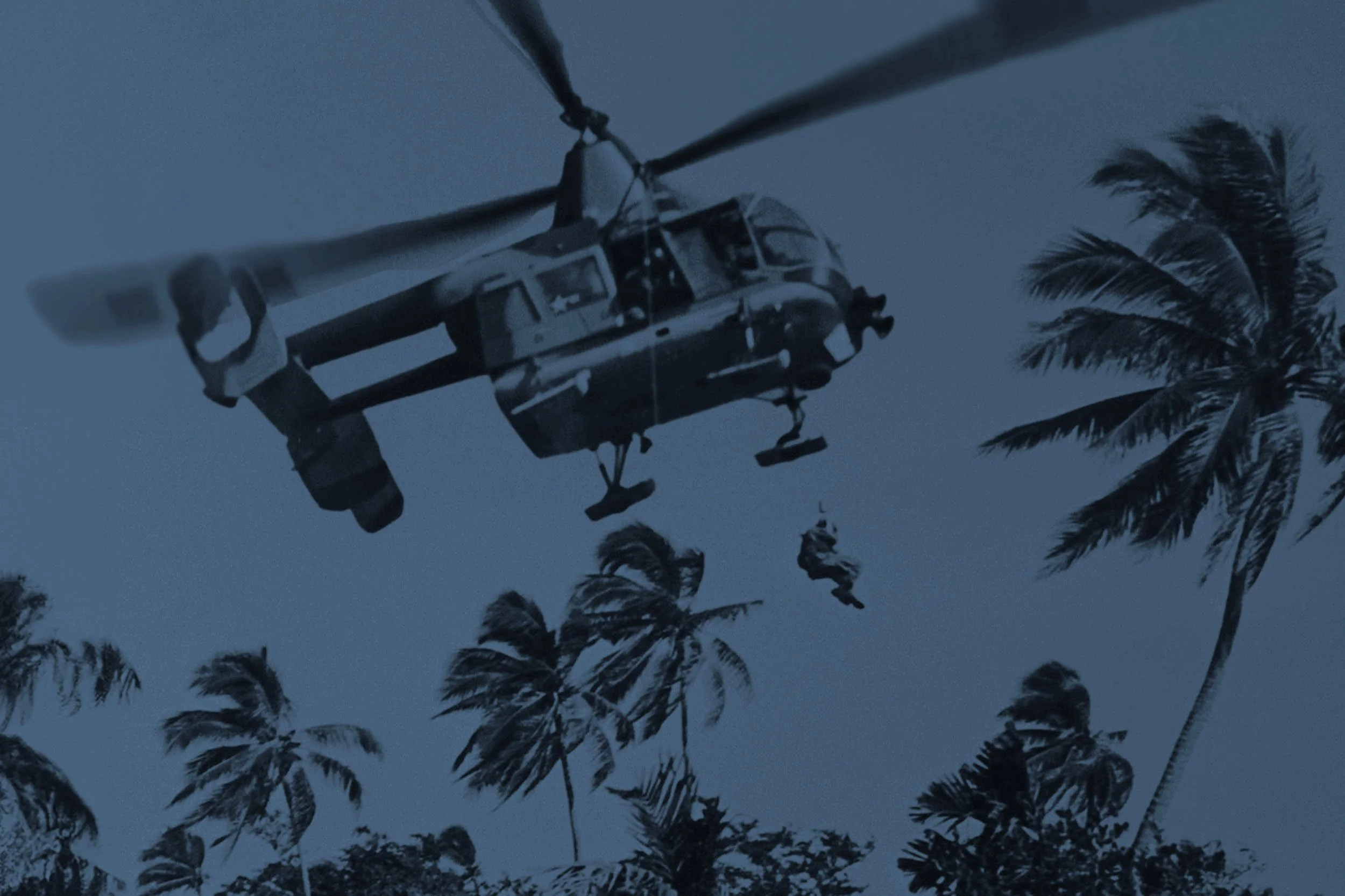
With the arrival of the rescue aircraft, Chief Etchberger, without hesitation, repeatedly and deliberately risked his own life, exposing himself to heavy enemy fire in order to place three surviving wounded comrades into rescue slings hanging from the hovering helicopter waiting to airlift them to safety. With his remaining crew safely aboard, Chief Etchberger finally climbed into an evacuation sling himself, only to be fatally wounded by enemy ground fire as he was being raised into the aircraft.
Chief Etchberger’s bravery and determination in the face of persistent enemy fire and overwhelming odds are in keeping with the highest standards of performance and traditions of military service. Chief Etchberger’s gallantry, self-sacrifice, and profound concern for his fellow men at risk of his life, above and beyond the call of duty, reflect the highest credit upon himself and the United States Air Force.
Keeping the secret
He risked his life multiple times, and three of his crewmen made it out alive because of his sacrifice. Because the mission was highly classified, his wife, Catherine, was told of his actions nine months later and sworn to secrecy. She took the secret to her grave. Her sons would not learn the truth until two decades later, when the details were finally declassified.
CMSgt Richard L. Etchberger was 35 years old when he sacrificed everything for his country and for the lives of his brother-in-arms. He was laid to rest in his hometown, with Americans knowing nothing of his courageous actions.
He is honored at the Vietnam Veterans Memorial in Washington D.C., where his name is inscribed on Panel 44E, Line 15.

Sources
Air Force Historical Support Division: Etchberger—CMSgt Richard L Etchberger
U.S. Department of War: Medal of Honor Monday: Air Force Chief Master Sgt. Richard Etchberger
Air Force: Medal of Honor—Etchberger, Richard L.
The Airmen Memorial Museum: CMSgt Richard L. Etchberger
HistoryNet: Tribute – Cmsgt. Richard Etchberger: What He Did In Laos to Earn a Posthumous Medal of Honor in 2010
We Are The Mighty: The unknown story of Air Force Medal of Honor recipient Richard L. Etchberger
Military Times: Richard Loy Etchberger
Stars and Stripes: DOD agency IDs remains of 3 airmen killed at secret Laos radar site in 1968
Defense POW/MIA Accounting Agency: Tech. Sgt. Donald Kennebunk Springsteadah
Burial Site: Find a Grave

